Building a Zero-Trust Network Simulation with Micro-Segmentation and Adaptive Policies
Introduction
Zero-trust architecture is a security model that assumes no implicit trust—every request must be verified. To test such systems in a controlled environment, a realistic simulation is essential. This article describes how to construct a dynamic zero-trust network simulation using a graph-based approach for micro-segmentation, an adaptive policy engine that fuses attribute-based access control (ABAC) with continuous risk signals, and built-in detection of insider threats. The entire system is exposed via a Flask API, allowing mixed traffic to be generated and monitored in real time.
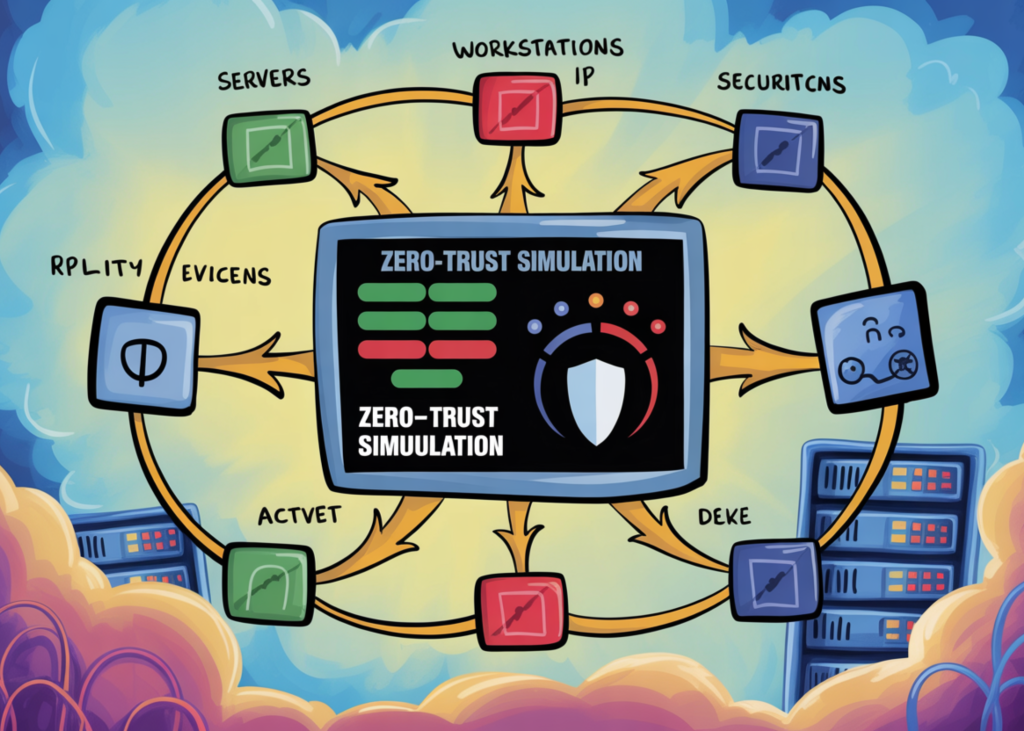
Modeling Micro-Segmentation as a Directed Graph
The foundation of the simulation is a directed graph that represents network zones, assets, and permissible paths. Zones such as public, DMZ, app, data, and admin are each assigned a sensitivity level (e.g., admin zone sensitivity = 0.95). Each zone contains assets like cdn or customer_db. Edges in the graph denote allowed communication paths—for example, from the public zone to the DMZ. This structure enables granular segmentation where every request must traverse a verified path.
Roles (customer, employee, analyst, engineer, admin, secops), device types (managed laptop, BYOD phone, unknown IoT), and network contexts (corp LAN, VPN, public Wi-Fi, Tor exit) are defined as metadata attached to nodes and edges. This metadata feeds into the policy engine to enforce context-aware access.
Designing an Adaptive Policy Engine
The policy engine combines ABAC-style permissions with live posture assessment. Each RequestContext dataclass carries fields such as user role, device posture (0 to 1), multifactor authentication (MFA) status, source and destination nodes, action (read, write, deploy, admin, exfiltrate), and risk indicators like behavior_anomaly and data_volume.
The engine computes a trust score using a sigmoid function that normalizes inputs. Factors include:
- Device posture – managed devices score higher
- MFA – adds a fixed boost
- Zone sensitivity – higher zones require stronger trust
- Location risk – public Wi-Fi or Tor exit lowers score
- Behavior anomalies – unusual patterns reduce trust
- Data volume – excessive transfers may indicate exfiltration
If the trust score drops below a configurable threshold, the request is denied and the user may be quarantined. The engine continuously updates policies based on changing risk signals.

Implementing Real-Time Threat Detection
Insider threats are simulated by generating lateral movement and exfiltration attempts. For example, an employee from the app zone attempts to exfiltrate data from the data zone. The policy engine flags these actions due to high data volume or anomalous behavior patterns.
Automated quarantine blocks malicious flows. When repeated violations occur, the system can isolate the offending node or user, preventing further access. This demonstrates how trust scoring and adaptive controls can stop both internal and external threats in real time.
Operationalizing via API and Simulated Traffic
The simulation is wrapped in a Flask API that accepts request data and returns access decisions (allow or deny) along with trust scores. Mixed traffic is generated by randomizing user roles, source/destination zones, actions, and risk indicators. The API logs every interaction, providing a rich dataset for analysis.
To visualize results, a simple matplotlib graph can be drawn showing the network structure and blocked attempts. This helps in understanding how micro-segmentation and adaptive policies work together.
Conclusion
By combining graph-based micro-segmentation, an adaptive policy engine, and insider threat detection, this simulation provides a realistic testbed for zero-trust architectures. It allows security teams to experiment with access rules, risk scoring, and automated responses before deploying them in production. The modular design makes it easy to extend with additional signals or policies.